Does Washing a Motor Work? An 11-Hour Test
Published 2026-07-24
Take a worn-out motor, clean it with solvent, and the RPM and readings really do improve — but is that youth restored, or just a last flicker? We took a decayed Mach-Dash PRO (fresh off a life test), measured it right after washing, then ran it 11 hours straight on the same measurement suite. The answer is blunt: dirt comes back off, worn parts do not — and for the first time the two are split cleanly by data. This is a follow-up to the 12-hour over-break-in test.
Three-line verdict:
▸ Recoverable — dirt (carbon, oxide film) washes off: constitution +5.9 (69.6→75.5), lower power draw, easier start — and it stays.
▸ Not recoverable — part wear (brushes, commutator) can't be saved: contact stability stuck at a poor 44% (a healthy unit is 24-26%). This is permanent.
▸ There is a cost — degreaser empties the oil from the bearing; skip re-oiling and it runs dry and seizes. Never skip that step.
1. One wash, and everything improves — like rejuvenation
First, before vs after (same unit, machine temperature within 1.5°C — a fair comparison). Almost every metric moves the good way:
| Metric | Before | After | Change |
|---|---|---|---|
| Constitution score | 69.6% | 75.5% | +5.9 ▲ |
| Power draw (no-load current) | 182 mA | 167 mA | −8% ▼ |
| Start-up voltage | 0.26 V | 0.19 V | −0.07 ▼ |
| 1V no-load RPM | 10,648 | 11,230 | +5.5% ▲ |
| Contact stability CV | 42.7% | 44.1% | Flat (still bad) |
Five metrics improve, one doesn't. The ones that improved were all caused by dirt — carbon and oxide film on the contact surface; wash it off and it clears. But the last line didn't move, and that line is the setup for everything below.
2. Run it 11 hours: the bonus gets paid back
Is that just-washed gain permanent? We ran it with one-tap break-in for 11 hours — about 470 equivalent rounds — measuring constitution along the way. It wasn't "better and better," nor "steadily worse": it settled, sinking from a virtual peak back to the real level.
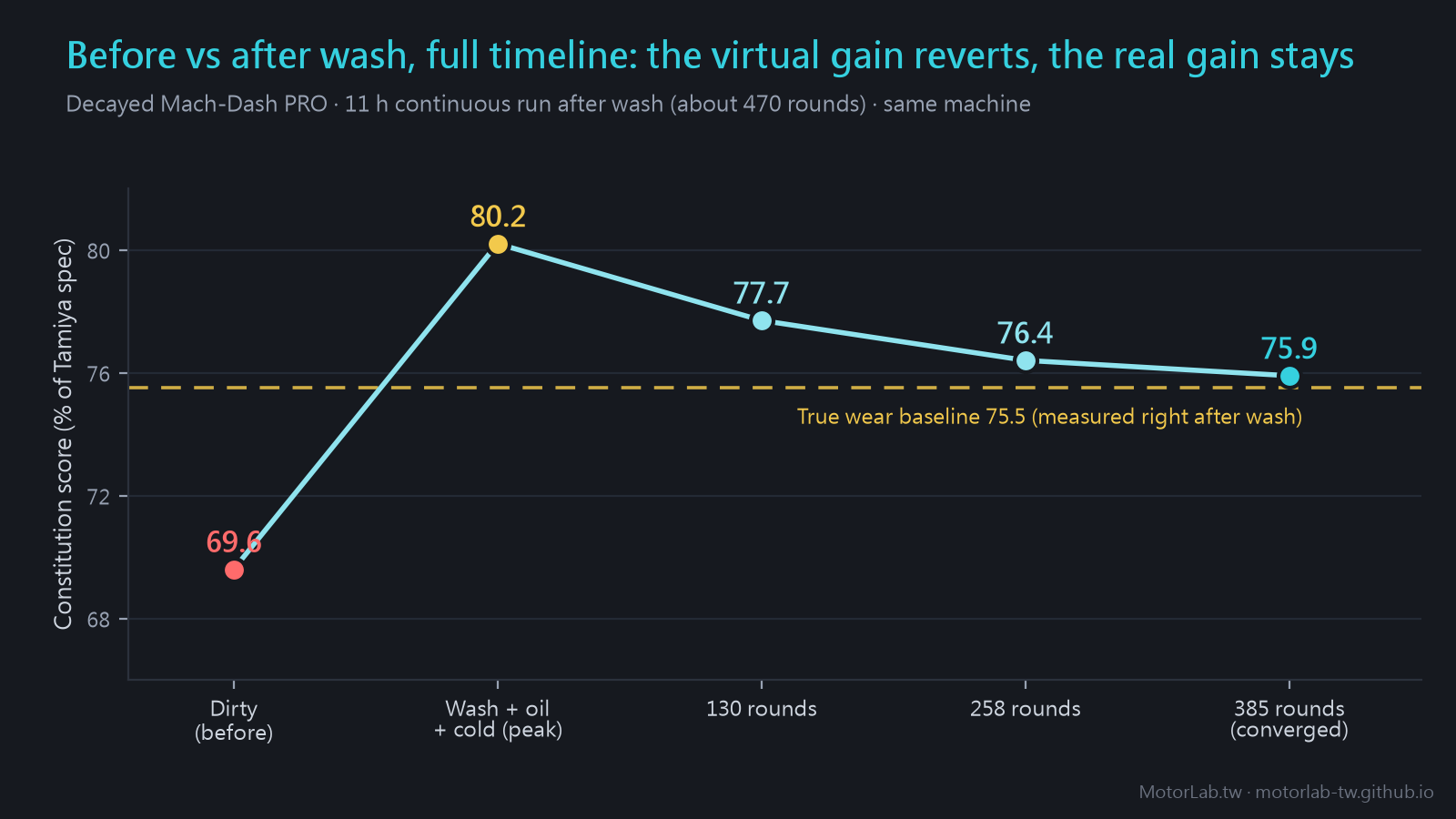
Read it in two layers: the 80.2 peak is a temporary bonus from wash + cold start + fresh oil film — run it and it reverts; but after it settles it holds at 75.5 and never falls back toward the pre-wash 69.6. Those 6 points (69.6→75.5) are genuinely washed back and here to stay. So "last flicker" is only half right: the virtual part is, but the real lift underneath is not.
3. Why does it converge? Because the underlying parameters stop moving
How do we know 75.5 is the "real level" and not still dropping? Look at two underlying parameters — torque constant Ke (the motor's magnetic constitution) and no-load current I0 (idle power draw). These are raw values read directly by measurement, harder to fool than the score; in the latter half they are essentially frozen:
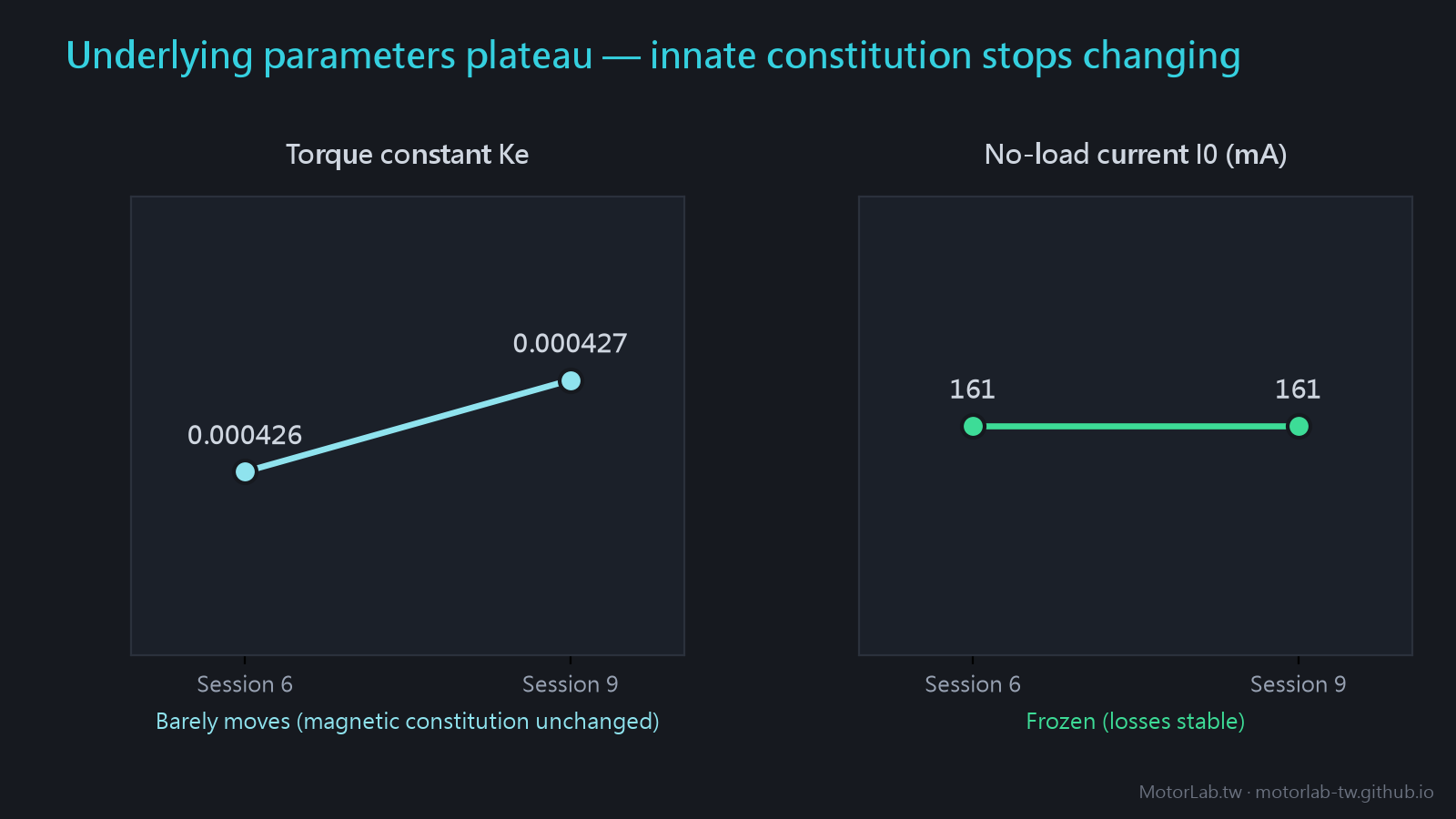
Underlying parameters flat → the small dip in constitution is just the contact surface settling, not parts deteriorating. It converged to a stable wear state — the dirt genuinely left, and what remains is this unit's true baseline.
4. The line that never moved: wear is permanent
Back to the setup from section 1 — contact stability CV, 42.7% before, 44.1% after: no movement at all. This metric measures how steady the brush-commutator contact is; lower is steadier. Healthy, normal units of this model sit around 24-26% (a same-rig measured baseline), while this one is stuck at 44% — clearly worse contact.
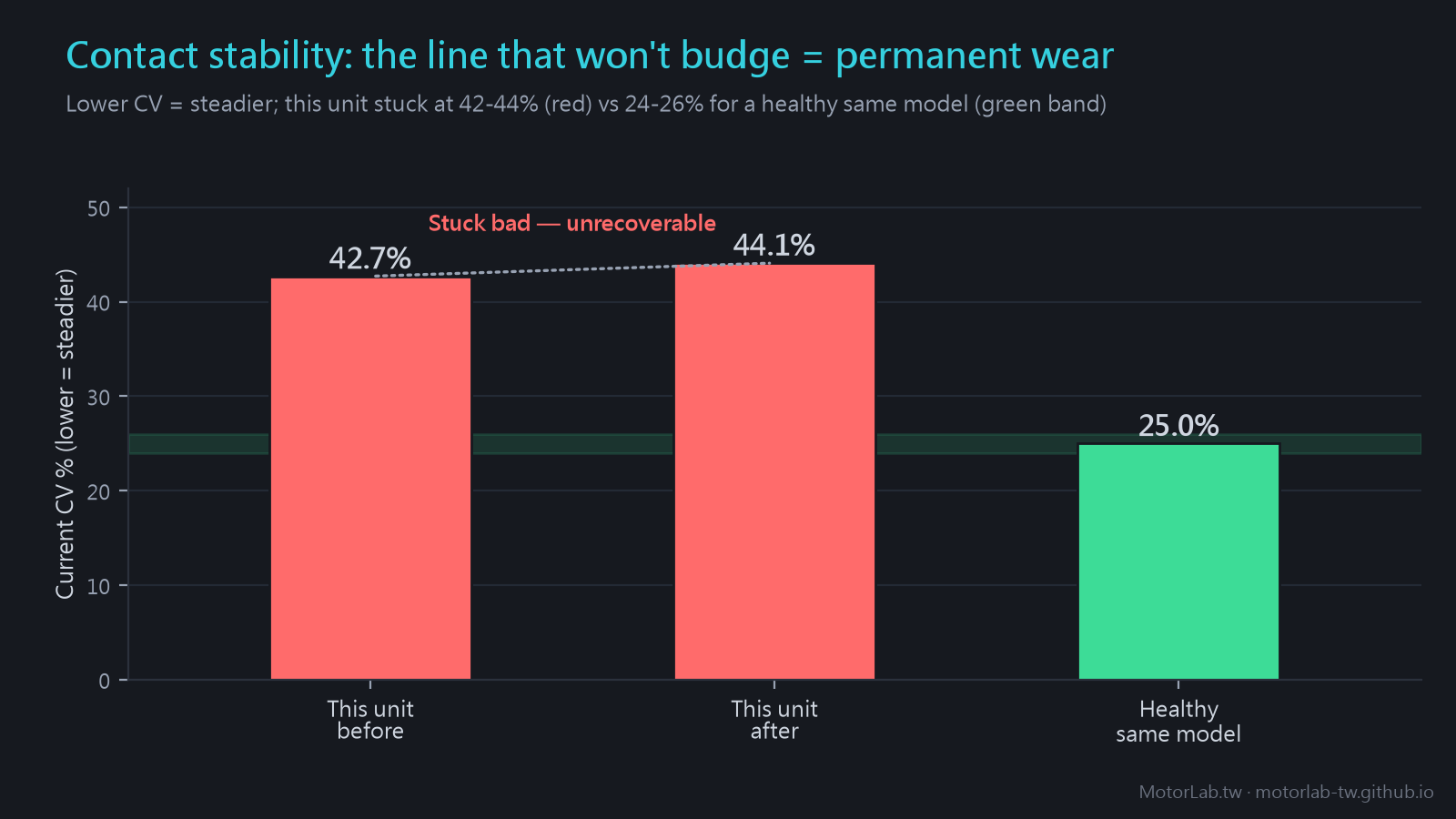
Solvent dissolves dirt, but metal that's been worn away does not come back — this is geometric damage, and no amount of soaking regrows it. So the verdict is unchanged: irreversible decay. Here, "decay" is split for the first time into two components: contamination (secondary, washable, +5.9) and wear (primary, unwashable, CV stuck at 44%).
5. Cautionary tale: degreaser will empty your bearing
Wash without re-oiling = dry-run seizure. On the first wash-and-mount, the motor collapsed mid-run at high speed — screech, current spike, jammed. The cause: degreaser is a solvent that pulls the oil out of the porous sleeve bearing too, and the dry bearing seizes. After re-oiling and letting it soak in, it ran fine, and a bearing coast test confirmed no permanent damage. Conclusion: if you wash a motor with solvent, re-oiling afterward is mandatory, not optional.
6. So, should you wash a motor?
Worth washing: the motor feels dull after long use and the data says "contamination-type decay" (heavier start, higher draw, but RPM still there). One wash reclaims the dirt bonus and it stays — great value. Not recoverable: if contact stability is already bad (CV far above normal) and true-value current exceeds the catalog band, that's part wear — washing only reclaims the small dirt slice, not the body. Time to replace the motor.
How to tell which you have? RPM alone won't separate them — both dirt and wear make a motor feel dull. It takes three numbers: constitution score (body health), no-load current (how dirty), and contact stability (degree of wear). That is exactly what the on-machine AI torque prediction tells you in about fifteen minutes.
Test conditions:
1. Mach-Dash PRO (a decayed sample after a life test)
2. Cleaning: solvent wash, flush out residue, and re-oil the bearing
3. 11 hours continuous run (about 470 equivalent rounds), same machine
4. Measurement: AI torque prediction + brush contact stability test + bearing resistance test
5. 24-26% is a same-rig measured baseline for normal units of this model, not official data