Smart Break-In: Grind to Just Right, Then Stop
Published 2026-07-23
One tap and the machine breaks in, measures, and stops itself when the motor is done. How do we dare say "just right"? Because we took a brand-new Mach-Dash PRO and ground it for 12 straight hours — over 5.5 million revolutions — from new all the way to retirement, just to find the point where you should stop. This page has no adjectives, only the real data from that experiment: where the gains of break-in end, where the cost of over-break-in begins — and how smart break-in stops you between the two. It is also the opening chapter of our 15-motor, same-conditions test series: this experiment sets the method and the metrics; from here, we test all 15 Tamiya motors under identical conditions, one by one.
The gains are banked within the first hour
The vertical axis below is the current drawn at the same RPM — the motor power draw, the one thing break-in truly improves; the horizontal axis is cumulative break-in time, and every point is a real measurement. In the first session, same-RPM current went 175 → 156 mA, about a 10% saving: the brushes bedded into the commutator and the internal "stickiness" was ground away.
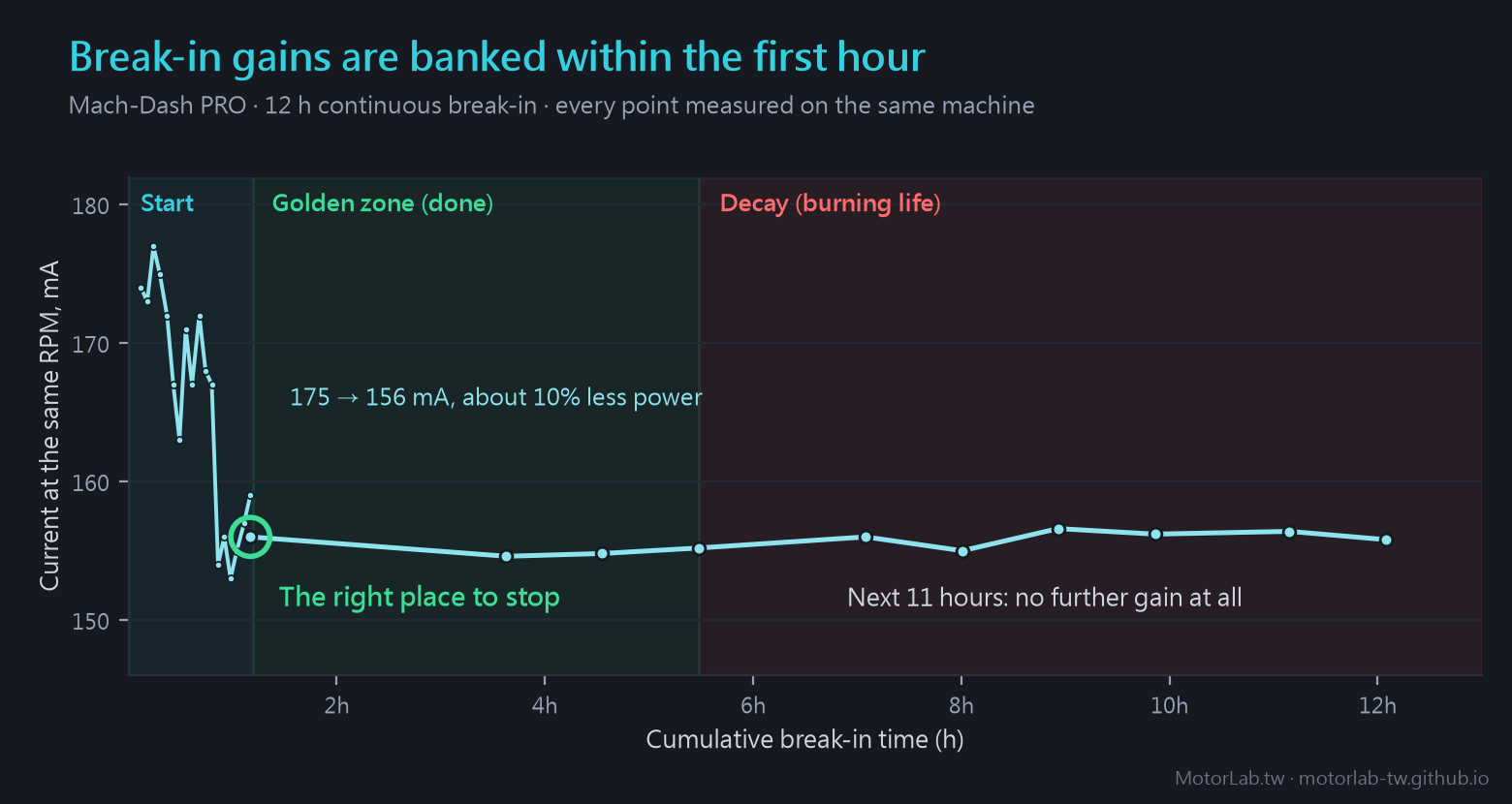
There is only so much "stickiness" to grind away. However many more sessions we ran, the power draw never dropped again — the done signal is actually very clear. The problem: people cannot see it. What people see is RPM.
What you see is RPM — and it lies to you
If you keep grinding after the motor is done (we did, on purpose), RPM at the same voltage keeps climbing (+4.9%). "RPM is still rising, so it is still improving" — almost everyone judging by RPM thinks exactly that, and keeps grinding.
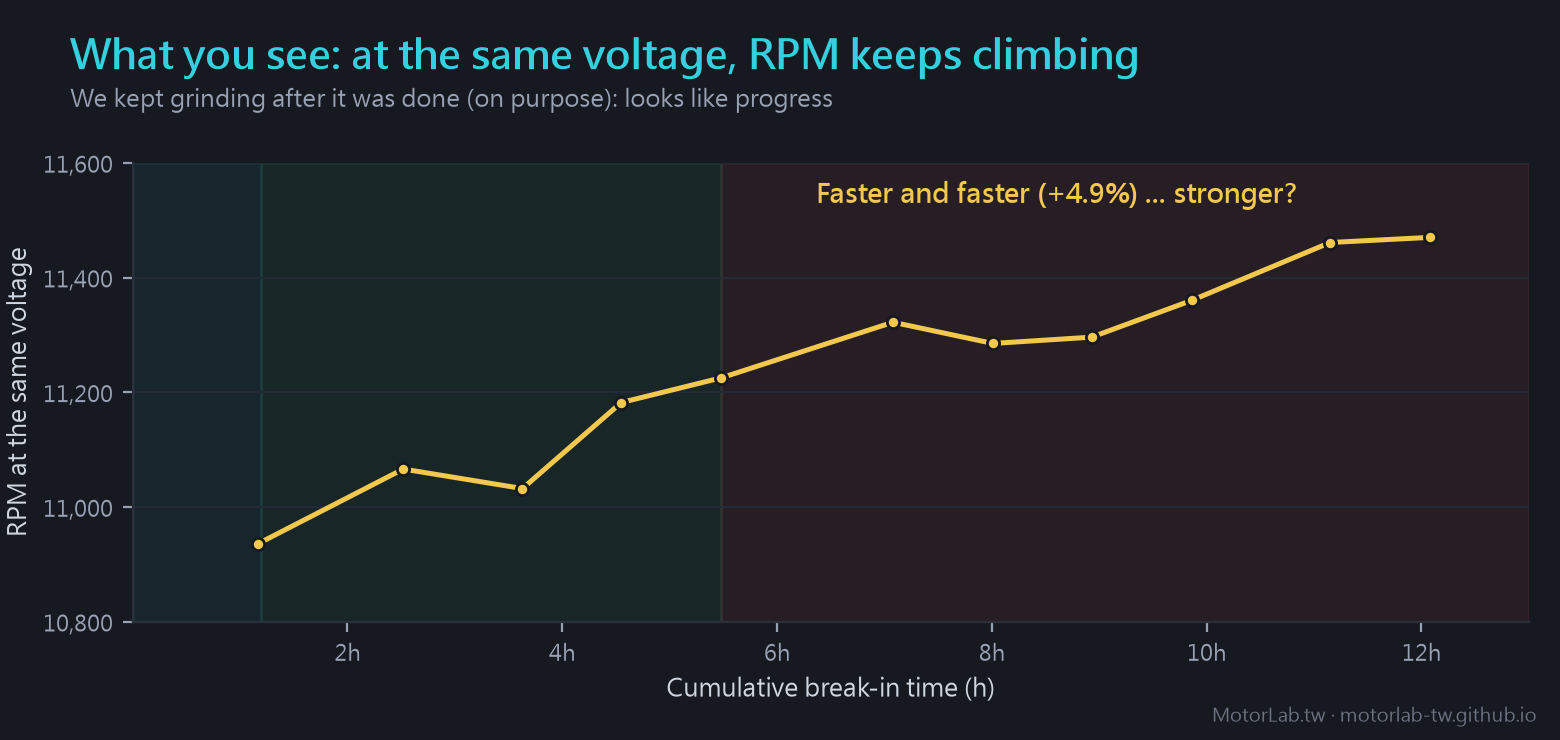
One textbook formula breaks the illusion: V = I·R + Ke·ω (voltage = resistive drop + back-EMF, magnet strength × speed). It says: at a fixed voltage, magnet strength (Ke) and speed (ω) sit on a seesaw — when RPM rises for no reason, the most common cause is not a stronger motor, but a lighter magnet end.
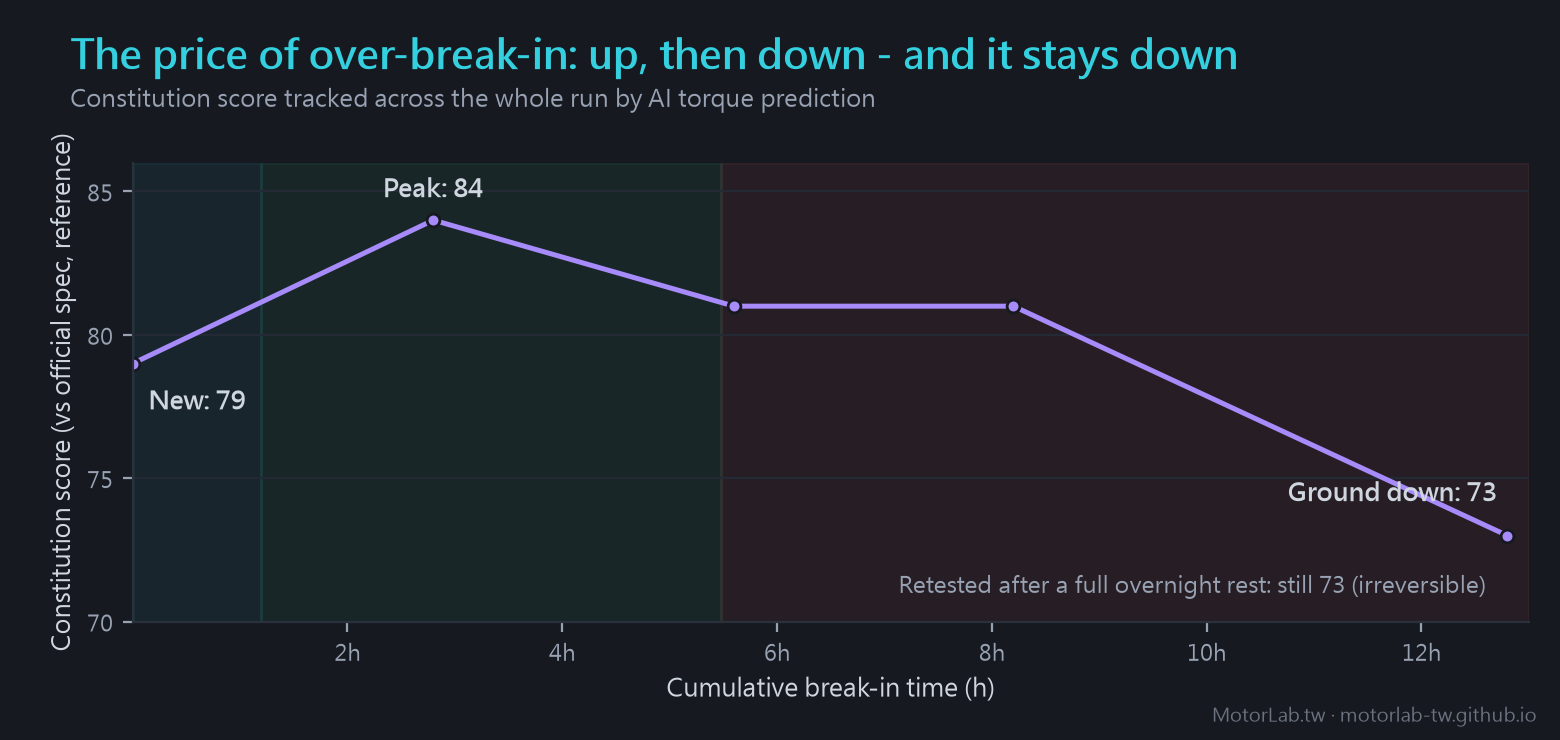
Magnet strength is not "used up" (a magnet on a shelf keeps it for a century) — it is knocked off: every commutation spark is a tiny reverse-field hit; over 5.5 million revolutions that is hundreds of millions of hits, and the magnets irreversibly weaken. In the very same stretch where RPM was "improving", this motor's constitution score was sliding.
The price of over-break-in is paid by the motor — irreversibly
Throughout the run we tracked the constitution score with AI torque prediction: break-in pushed it from 79 to a peak of 84 — the motor at its personal best; past the peak it slid all the way to 73, lower than brand new. Retested after a full overnight rest: still 73. Gained 5, lost 11, never coming back.
Smart break-in: hand "when to stop" to measurement, not to feel
The stop signal exists and can be measured — but people staring at RPM cannot see it, and the RPM illusion keeps urging them on. Smart break-in does three things for you:
- It grinds and measures by itself — fully automatic after one tap: the system breaks in at progressive speeds while measuring continuously, alternating forward and reverse so both brush faces bed symmetrically.
- It stops at steady state, automatically — it keeps watching the break-in metric and stops with a beep the moment it detects "no more improvement" — not one session more, never trading your magnets for fake RPM.
- You see the whole process — live rounds, convergence progress and the metric curve (per-round points + moving average); a flattening curve means nearly done. A time cap backstops it, and you can stop gracefully anytime.
Break-in is spending from a budget: there is only so much "stickiness" to remove, and magnets have finite life. The moment power draw stops falling is the moment to stop — smart break-in hands that call to measurement and stops you at just right.
Next: 15 motors, one set of conditions
This 12-hour run fixed the test framework for the whole series: the same machine, the same break-in and measurement flow, and the same three dimensions — same-RPM current (power draw), same-voltage RPM, and constitution score. From here we put all 15 Tamiya motors through identical conditions: where each golden zone sits, how early the stop point arrives, and how much over-break-in costs — published one by one, all collected in Benchmarks.
Test conditions:
1. Mach-Dash PRO
2. 12 hours of continuous low-speed break-in
3. All data measured on the same machine
4. Physics: the DC motor voltage equation V = I·R + Ke·ω
5. Constitution scores are reference values against Tamiya official spec — read the trend