Why Break In a Motor at Fixed Speed, Not Fixed Voltage
Published 2026-07-14
Almost every break-in method sets a voltage and lets the motor run — fixed-voltage break-in. RPM? At most it gets measured, not controlled. But physically, break-in quality is set by RPM (the sliding speed at the contact face), not voltage. Here is fixed-voltage vs fixed-speed, and where they differ.
What break-in is actually grinding
A new motor's brush is flat and touches the round commutator on just a line; break-in grinds the brush into an arc that matches the commutator, taking the two from a single-line contact to a stable, seated one. That grinding happens at the sliding contact face between brush and commutator. Physically it is governed by sliding speed (commutator surface speed ∝ RPM), contact pressure, current density and temperature — and the key variable you can control in real time is RPM.
The physics problem with fixed voltage
Fixed-voltage break-in = you fix V, and RPM is set by the motor's current state (V ≈ Ke·ω + I·R). Three problems:
1. RPM drifts within a run — as break-in proceeds, contact resistance R shifts and temperature nudges Ke, so at fixed voltage the RPM keeps drifting; the sliding speed becomes a moving target and the break-in condition changes as it goes.
2. Different motors spin at different RPM — at the same 3V, motors of different constitution turn at different speeds, breaking in at different sliding speeds — not reproducible, not comparable.
3. Commutation conditions drift too — RPM drift means commutation-frequency drift, so spark and heat drift as well. You control voltage, but what actually grinds the contact face is RPM — voltage is a proxy one step removed that also shifts as the motor changes.
What fixed-speed (closed-loop) gets right, physically
Closed-loop speed control = you fix RPM, and feedback adjusts voltage to hold it; voltage becomes the compensating free variable. Four physical wins:
Locks the sliding speed — the brush is ground at a constant surface speed, seating more uniformly.
Same baseline across motors — every motor breaks in at the same RPM regardless of constitution — reproducible and comparable (this is also why measurement locks the speed; see the R-curve article below).
Fixed commutation frequency — spark and heat conditions stay stable.
You can target a low RPM directly — low RPM = low commutation energy = gentle bedding; whereas at low voltage, individual differences make RPM unpredictable (a slow motor may barely turn).
Fixed-voltage vs fixed-speed: the physics side by side
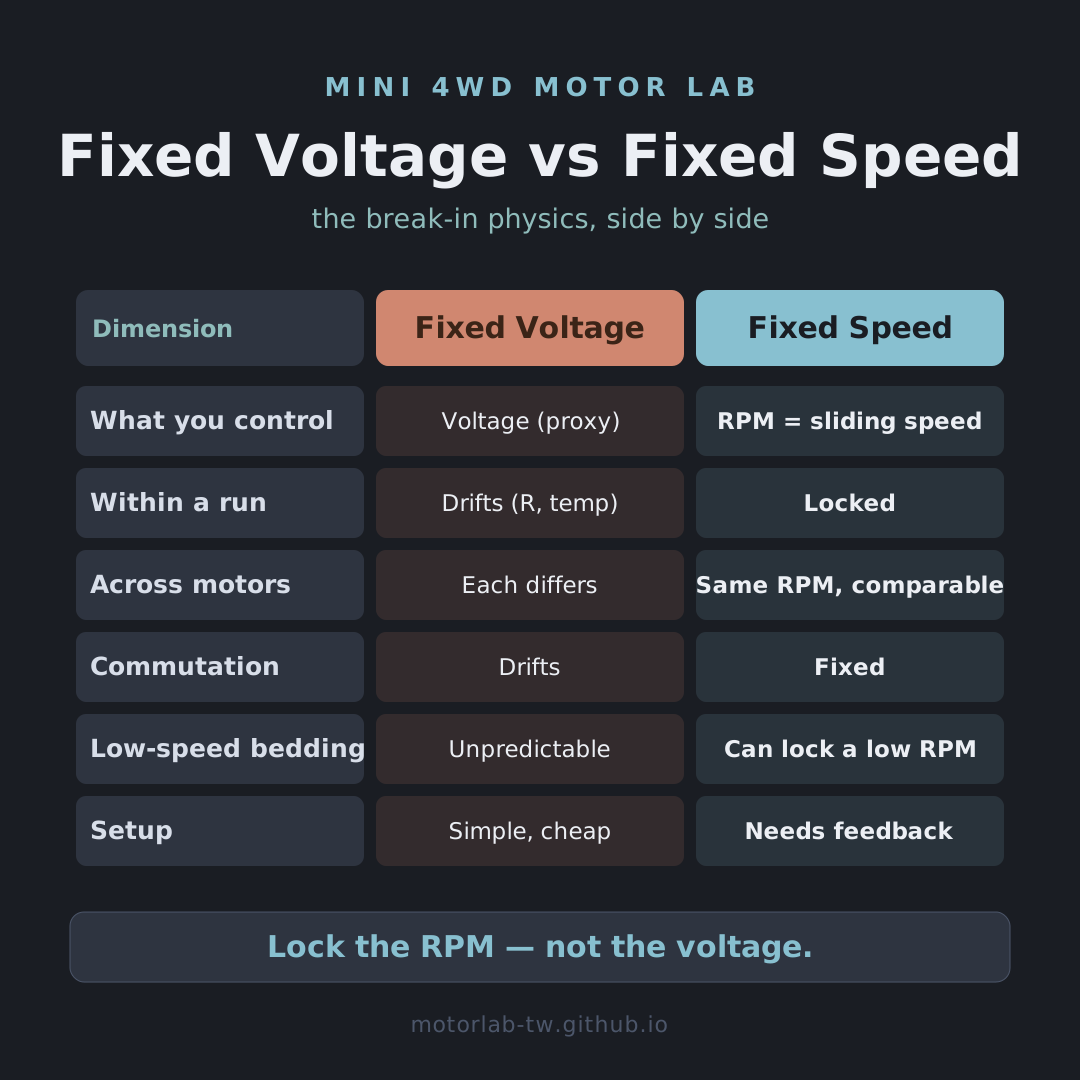
| Dimension | Fixed voltage | Fixed speed (closed-loop) |
|---|---|---|
| What you directly control | Voltage (a proxy) | RPM = sliding speed (the key one) |
| Condition within a run | Drifts with R / temperature | Locked |
| Consistency across motors | Each at a different RPM | Same RPM, comparable |
| Commutation frequency | Drifts | Fixed |
| Low-speed bedding | Unpredictable at low V | Can lock a low RPM |
| Implementation | Simple, cheap (open loop) | Needs feedback control |
The honest trade-off
Fixed-speed isn't free: it needs real-time RPM measurement and feedback voltage adjustment (closed-loop), which is more complex than just setting a voltage; and at the very start it must break static friction first, not just push with low voltage. Fixed voltage wins on being simple and cheap. One clarification: this article is about the control method (voltage vs speed), not the target value — whether you use 2.4V (NiMH) or 3.0V (alkaline), or which RPM to lock, is a separate "pick the setting by your race battery" question.
In one line: break-in quality is set by the sliding speed at the contact face, and that sliding speed is RPM. Fixed voltage controls a proxy that drifts; fixed speed controls the physical variable that actually grinds the contact face. To break in precisely, reproducibly, and comparably across motors, the thing to lock — physically — is RPM.
Further reading: how to read break-in progress from data — the R break-in curve; picking motors worth breaking in first — select before break-in; the full physics and procedure — the complete break-in guide.
This physical framing is conceptual; real break-in still involves brush type, time, temperature and cooling. The benefit of fixed-speed is turning the break-in condition from a drifting proxy into a directly controllable physical variable — not a guarantee that any single value is optimal.