How Long to Break In a Motor? 560 Runs on One Motor, Answered
We ran one Mach-Dash PRO 560 times under locked speed, low voltage and no load, plotting its internal resistance (a proxy for the brush–commutator contact state) against the cumulative run count. The line captures a motor's whole arc — from new, through fully broken-in, to decline — so you can tell which stage the motor in your hand is at: still needs running-in, at its best, or past its peak.
Mini 4WD motor break-in usually rides on feel and experience; hundreds of continuous measurements spanning a whole life cycle have almost no public precedent in the hobby. Below is our log of one motor measured 560 times in a row.
“Break-in widens the contact, so current flows easier and the motor runs faster” — that’s the common intuition in the hobby. So this log may make you pause: the R line rises as break-in proceeds. Does break-in make the motor better or worse? The key: this R measures the brush–commutator contact state, not the motor’s speed; its rise isn’t bad news — it’s the direct trace of the contact settling in. The chart below breaks that down.
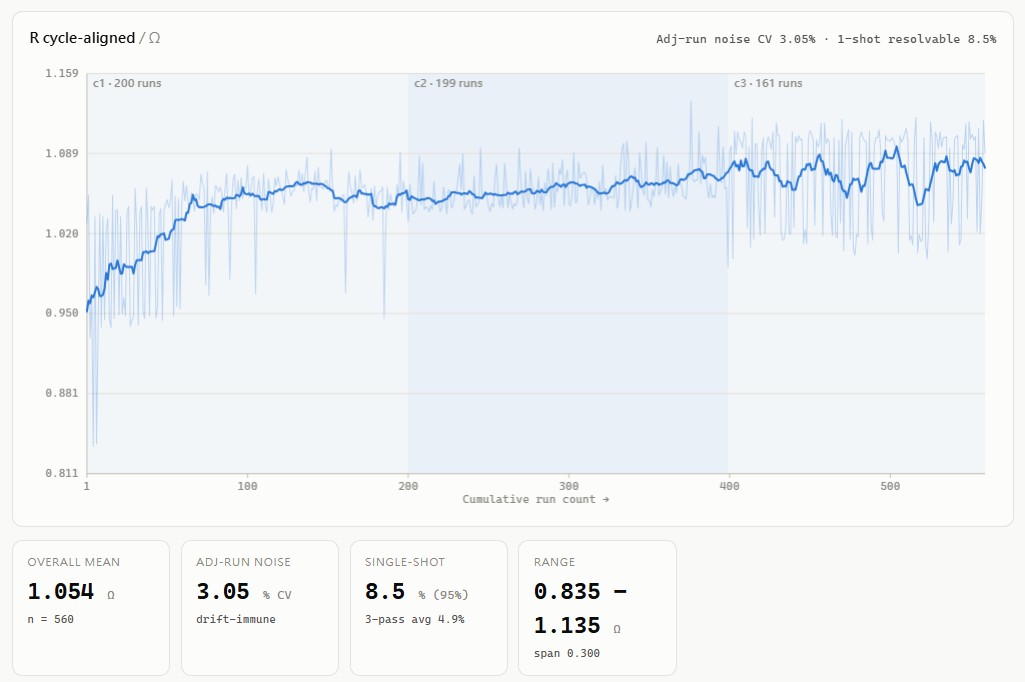
The curve's three stages
Newborn stage (early rise, first ~80 runs) — contact surface forming: at first the brush and commutator faces haven't seated; running builds a stable interface film on the contact surface, so contact resistance climbs slowly. This rise is break-in happening, not degradation; the slope is steepest here, where the contact state changes most.
Golden stage (mid plateau, ~80–400 runs) — settled: the faces have seated and the interface film has stabilized, so resistance flattens and further change shrinks markedly. This band is the stable working region after break-in — best repeatability, and the state window best suited for racing.
Decline stage (rising scatter, after ~400 runs) — contact stability dropping: the raw readings (faint line) swing more run-to-run; the mean still holds roughly flat, but single-shot scatter rises. This reflects the brush's late-stage contact stability falling — an early sign the peak is past, not an immediate failure.
Three practical readings for break-in
1. The curve's flattening point is where break-in converges. The first ~80 runs capture most of the effect; beyond that is diminishing returns — more running barely improves contact resistance and just spends brush life. Whether to keep breaking in reads most directly off whether the curve has flattened.
2. A rising resistance is the normal shape of break-in, not an anomaly. Watch for the two opposite cases: a curve that never moves (break-in may not be reaching the contact surface), or one that is scattered throughout (poor contact, or a loose jig/clamp). A steady rise that then converges flat is the signature of good break-in.
3. Use “runs to converge” to compare a motor's constitution. Motors that settle fast versus those that take long have different contact conditions; the curve turns “break-in speed” into a comparable metric, and cross-reads well with selection data.
Test conditions
Motor: Mach-Dash PRO
Method: PID speed-lock, no load, low voltage throughout (below 1.2V)
5 speed steps: 4,000 / 6,000 / 8,000 / 10,000 / 12,000 RPM
~1.5 min per run, 560 continuous runs total
Further reading: screen for motors worth breaking in first — select before break-in; the full physics and 10-stage procedure — the complete break-in guide; the measure / compare / judge-health framework — the three-pillar methodology.
This curve reflects a relative trend for one motor under one set of measurement conditions, not an absolute resistance value; absolute values across machines or conditions should not be compared directly. Its worth is turning a single motor's break-in progress and decline into a readable time series.