Can a Dead, Retired Motor Be Saved? An Electric-Shock Repair Experiment
Published 2026-07-27
Can a retired, magnet-drained Mach-Dash PRO be brought back? Using MotorLab + an external power supply, we gave it one "electric-shock repair" — borrowing the principle of the industrial Variable Flux Memory Motor (VFMM) (a current pulse re-magnetizes the magnet) and testing it on a Mini 4WD motor. The result is interesting: magnetism can be recharged (reversible), wear cannot (irreversible). This is a follow-up to the motor-wash experiment, taking the same retired sample one step further.
Three-line verdict:
▸ Magnetism: rechargeable (reversible). One 9V shock re-charges a retired motor's drained magnetism +18% — but it's temporary; it bleeds off again as you run, not permanent.
▸ Wear: unrecoverable (irreversible). Brushes and commutator are physical wear; neither shock nor wash puts material back.
▸ The principle: borrowed from the industrial Variable Flux Memory Motor (VFMM) — a current pulse re-magnetizes the ferrite magnet.
1. How the experiment was run
The flow is simple: pre-shock measurement → shock → motor wash → post-shock measurement → long run under AI Smart Break-In (measuring at intervals) → done. The shock was an external supply at DC 9V, forward, 60 seconds (a pulse shock); afterward we washed off the carbon the shock produced, re-oiled, and remeasured — clearing the transient dirt first so we read only the permanent effect of the shock, not a dirt-blurred one. Everything was measured with on-machine built-ins: AI Torque Prediction, AI Smart Break-In, the brush contact-stability test, and the bearing drag test.
2. Magnetism: one shock, recharged +18%
We used a hard-to-fool metric as the "demag detector" — the magnet index Ke. Before the shock it sat steady at 0.000415; after, it jumped to 0.000491, +18%. And not just Ke: at fixed voltage the RPM dropped, at the same speed it needed more voltage, and at the same speed it drew less current — four independent lines all pointing the same way, "stronger magnet." That is the textbook signature of re-magnetization.
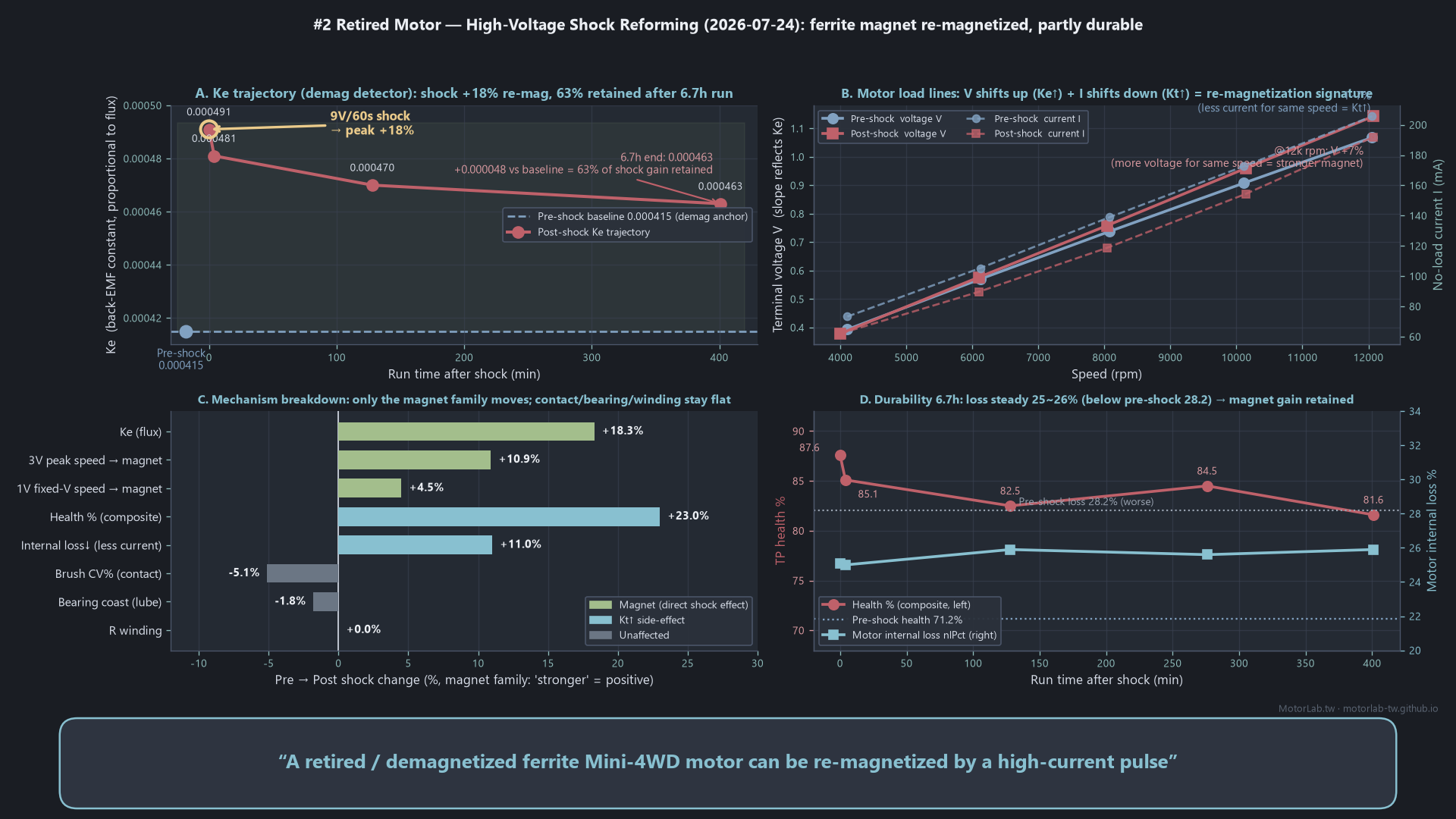
The top-left panel is the recharge trajectory: from the retired baseline, one shock jumps to the peak. This step proves it — a retired motor's drained magnetism can be recharged.
3. But only temporary: it bleeds off as you run
How long does it hold? We then ran it under AI Smart Break-In for 6.7 hours, sampling Ke along the way. It did not drain all the way, nor lock in place — magnetism sank slowly from the peak and finally kept about 63% of the shock gain, with the decay slowing down, trending toward a new level higher than pre-retirement. So the "magnetic revival" is real, but it slowly bleeds off again with normal use — not a one-and-done fix.
4. Wear: neither shock nor wash brings it back
The magnet came back — what about the contact face? Look at the mechanism breakdown (bottom-right panel): the only thing that moves is the magnet family (green), while brush contact stability, bearing drag and winding resistance barely move (grey). So the shock only topped up the magnet and did nothing for wear — brushes and commutator are physical wear, and metal ground away does not come back; no shock or wash restores it. The constitution score looks better mostly as a knock-on of the stronger magnet, not because the contact face was actually repaired.
The shock has a cost — do not just try it. A high-voltage shock itself erodes the contact face: no help for an already-worn motor, and only damage to a healthy one. This is also an n=1 single-unit experiment with the mechanism not fully pinned down; a higher voltage or longer pulse could instead accelerate demagnetization and erosion. This is an experiment log, not a how-to — do not shock a serviceable motor yourself.
5. So — can a retired motor be saved?
It depends on how it "died." If it is lost magnetism (demag), there is a chance to recharge some of it back — but temporarily. If it is contact-face wear (brush, commutator), neither shock nor wash saves it; retire it. In one line: a shock can bring a retired motor's magnetism back from the dead, but a worn-out contact face is beyond saving. How to tell which you have? The on-machine AI Torque Prediction breaks it down in about fifteen minutes — magnetic health, power draw, and contact stability, three numbers each telling their own story.
Test conditions:
1. Mach-Dash PRO (retired sample)
2. High-voltage shock: external supply, DC 9V / 60 s (pulse shock)
3. Cleaning: eco degreaser, DC 1.5V / 3 min, and re-oil the bearing
4. AI Smart Break-In long run, 6.7 hours, same machine
5. Measurement: AI Torque Prediction + brush contact-stability test + bearing drag test