Does Conductive Oil Really Help Motor Break-In?
Published 2026-07-17
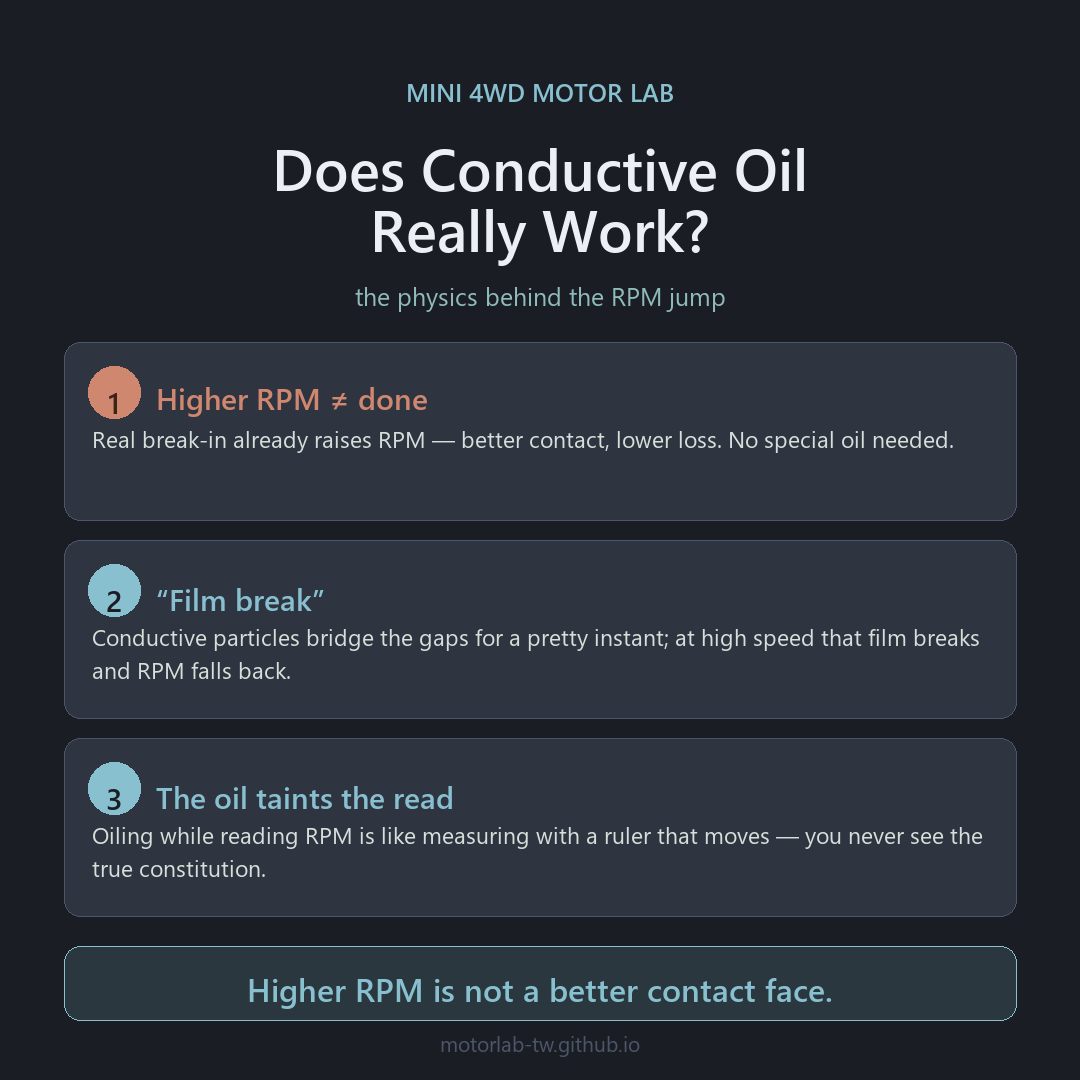
Conductive break-in oil is a hot item these days — add a drop and the RPM jumps, the sound smooths out, and it looks like the break-in just leapt forward. But does “higher RPM” really mean “the motor is broken in”? This article takes the oil apart with physics: what’s real about it, what’s illusion, and why the RPM you read while the oil is in there is not the motor’s true constitution.
What break-in actually shapes
Break-in doesn’t touch the magnets or the windings — it shapes the contact face between brush and commutator. A new motor’s brush is flat, touching the round commutator on just a small patch; break-in wears that brush into an arc that beds against the commutator, growing the contact area, lowering contact resistance, and letting the motor reach its designed RPM. A real-world Japanese log: a Power-Dash went from ~29,000 to 33,200 RPM (+4,000) — that gain is real break-in, better contact and lower loss. It happens without any special oil at all.
Why the oil makes it “faster” instantly
Conductive break-in oil usually does two things: it lubricates, helping the brush wear open faster (real); and it carries ultra-fine conductive particles that temporarily bridge the gaps in the brush-commutator contact. That second part drops contact resistance instantly, so the RPM spikes. The catch: that drop comes mostly from the oil film / carbon conducting, not from the contact face actually getting better. The Japanese community has a vivid term — “hikimaku-gire” (film break): the conductive film gives lovely RPM at first, but at high speed that film eventually breaks down, and the pretty numbers fall back.
Nice short-term vs the long-term catch
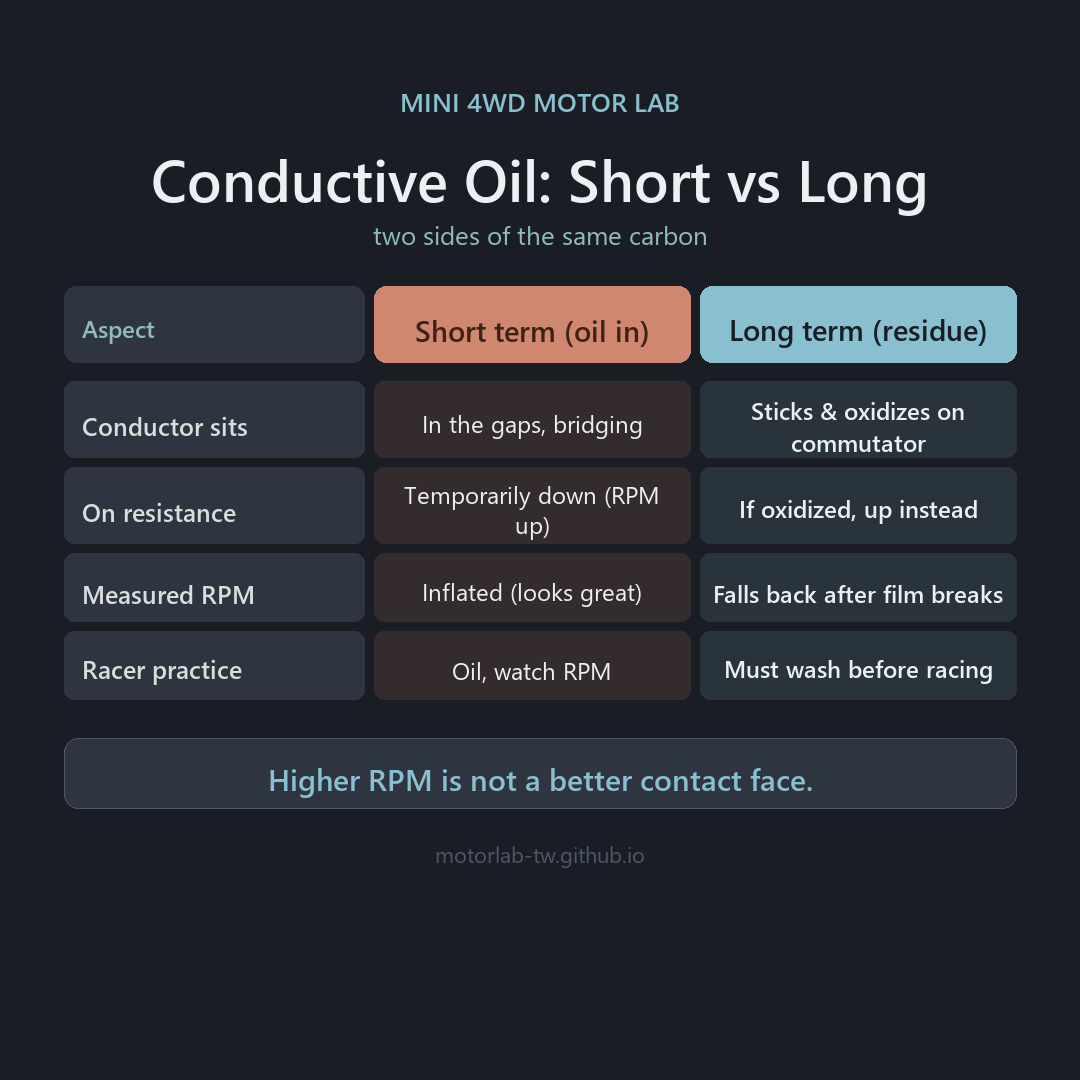
| Aspect | Short term (oil in) | Long term (residue) |
|---|---|---|
| Where the conductor sits | In the contact gaps, bridging | May stick & oxidize on the commutator |
| Effect on resistance | Temporarily down (RPM up) | If oxidized residue, up instead |
| Measured RPM | Inflated (looks great) | Falls back after film breaks |
| Common practice | Run with oil, watch RPM | Must wash before racing |
Distinguish two kinds of “carbon”: the graphite film from a brush’s normal wear is a good thing — low resistivity, heat-tolerant, the normal product of a mature break-in; whereas carbon residue left by the oil and not washed out, if it sticks and oxidizes, is the real resistance risk. That’s why almost all these oils demand “wash after break-in” — the product itself admits the pretty numbers during oiling are temporary. Japanese racers warn: unwashed break-in oil keeps soaking in and brings the motor’s peak earlier, i.e. earlier decline.
Pros and cons (a fair look)
| Pros (real) | Risks (watch out) |
|---|---|
| Lubrication genuinely speeds the brush wearing open | Part of the RPM gain is temporary conduction — washes off |
| Suppresses sparking, smoother short-term running | Oxidized residue may raise resistance long term |
| A pre-race boost, great paper RPM | Measurement is off while oiled — selection misled |
So conductive oil isn’t “unusable.” Splashing on a pre-race RPM boost and washing it off after is a racer’s free choice — plenty of top players do exactly that. The real question isn’t “does conductive oil work,” it’s — how do you know how far this motor is actually broken in? As long as you’re oiling and reading RPM to judge, the answer is never clean, because the oil itself contaminates the reading.

The core of the debate: paper number, or true constitution
| Aspect | Paper-number camp | Constitution camp |
|---|---|---|
| What they want | Pre-race paper RPM, right now | The motor’s real, long-term constitution |
| To them, conductive oil | Works (a few k RPM, wash after) | Reference only (carbon must wash; need clean data) |
| Basis of judgment | A single RPM point while oiled | A measurement trend in clean state |
This debate has no single answer — because the two camps want different things. Instead of “does conductive oil work,” the better question is: do I have a method, uncontaminated by oil, to see this motor’s true break-in state?
How to see the “true” break-in state
The deadlock with conductive oil is that it is both the process and the measurement: you break in with it, and judge by the RPM you see while breaking in — like measuring length with a ruler that moves on its own. To see the true state, the only path is to separate measurement from process: in a clean state, free of oil-film interference, judge break-in by a physical quantity that can’t be faked. Break-in progress is fundamentally set by the accumulated count of the brush passing the commutator (commutation frequency ∝ RPM), so watching the motor’s trend at fixed RPM is far more reliable than a single RPM point taken while oiled. See why break in at fixed speed, not fixed voltage and how long to break in: the 560-run curve.
Zoom out: a good break-in process isn’t about squeezing the highest paper RPM out of one motor — it’s about raising the odds that a good motor shows up, and making each one’s state repeatable and comparable. Conductive oil can hand you a pretty instant, but to pick the best-constitution motor within a model, and to have a process that comes back the same, what you need is real measurement in a clean state — not a bottle that rewrites the answer for you. For the selection angle, see select first, break in later.
This is a fair account of break-in physics and racer practice; it does not dismiss conductive oil — its lubrication and short-term smoothness are real. The point is to separate “the paper number while oiled” from “the motor’s true constitution in a clean state”: different uses, don’t mistake the former for the latter.